Marion Nicoll Gallery
Current
Exhibitions
01 - Main Space
Lacuna / Faith Maningas
11.20.2026 - 12.15.2026
Reception Nov 26 6-8pm
Exhibition Statement
Lacuna - an interval, blank space, or a missing part of a whole.
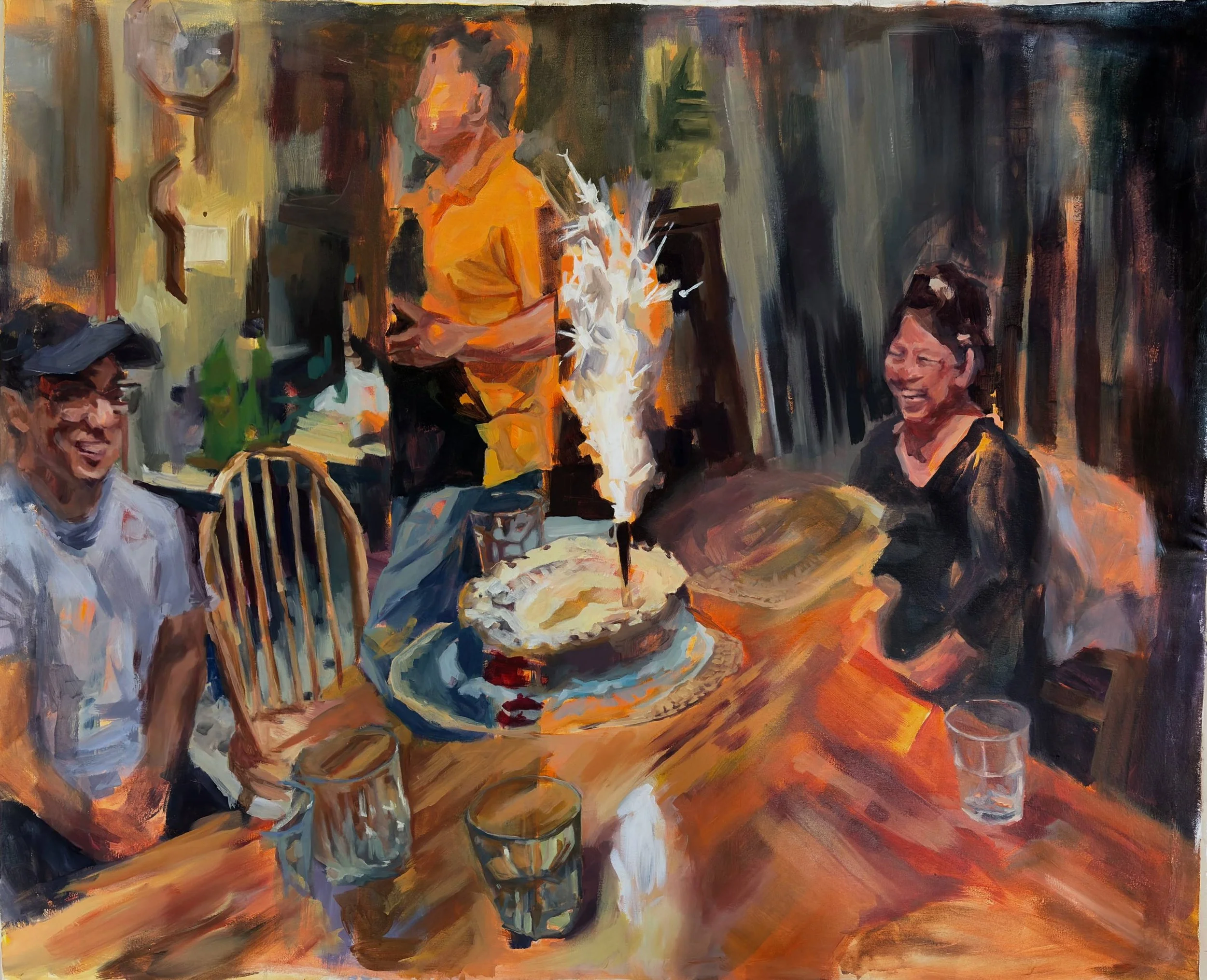
Through this series of paintings, I investigate the slippery nature of memory and how easily it slips between our fingers as we attempt to grasp its remains. The work is caught between resistance and acceptance, between what can be held on to and what to let go of, and carrying the grief that comes with reaching toward that acceptance. It holds both the comfort of remembering and the longing for what cannot be fully restored, offering not a resolution, but proof of what was once whole.
Two kinds of memory move through this exhibition. I explore a return to a significant time in my life, and I paint these moments as if assembling a puzzle without the box, drawing each scene from more than one angle and one moment at once. Other paintings I work through differently, painting figures and places from separate points in time, and stitching them with my own memory from a life before my time. The two blur into a hybrid memory neither fully lived nor fully inherited, built in an effort to reach back towards what has already slipped away.
My process begins with creating a combination of hand-cut and digitally superimposed collages, using images from family archives, which then jumpstarts the beginning of my paintings. Each collage is, when built towards a specific narrative, guided by intention and, when fabricating scenes beyond the original context, led by intuition. Using acrylic paint on canvas, the nature of the paintings oscillates between clarity and ambiguity, where certain areas are carefully rendered and laid alongside brushstrokes that remain loose and gestural. By overlayering a warm yet subdued colour palette, the vibrant underpaintings illuminate through the surface as temporal residue.
To collage is to extract. I remove figures from their original context and relocate them, either filling the space they leave behind or letting them sit empty. Whether that space is intentional or not, it still remains. This physical act mirrors the nature of memory, where certain details of an event or a person slip away and even blur between moments. No matter how deliberately we search for them, they do not always return. Yet after a loss, memory is often the sole survivor standing amidst the debris between us and what we have lost. Memory does not always return what we ask of it, no matter how much we beg. It cannot be trusted to stay still - it erodes, drifts, and leaves missing pieces over time.
Artist Statement
Faith Maningas is a Calgary-based artist working primarily in acrylic and oil on canvas. Her practice draws from personal experiences and family photographs and archives, which she transforms through hand-cut and digital collages into paintings. Working between representation and abstraction, she investigates the instability of memory and grief through the relationship between photography, collage, and painting.
@artbyfaithh
02 - LRT Space
The Long Aftermath / Noor K
11.02.2026 - 12.17.2026
Reception Nov 26, 6-8PM
Exhibition Statement
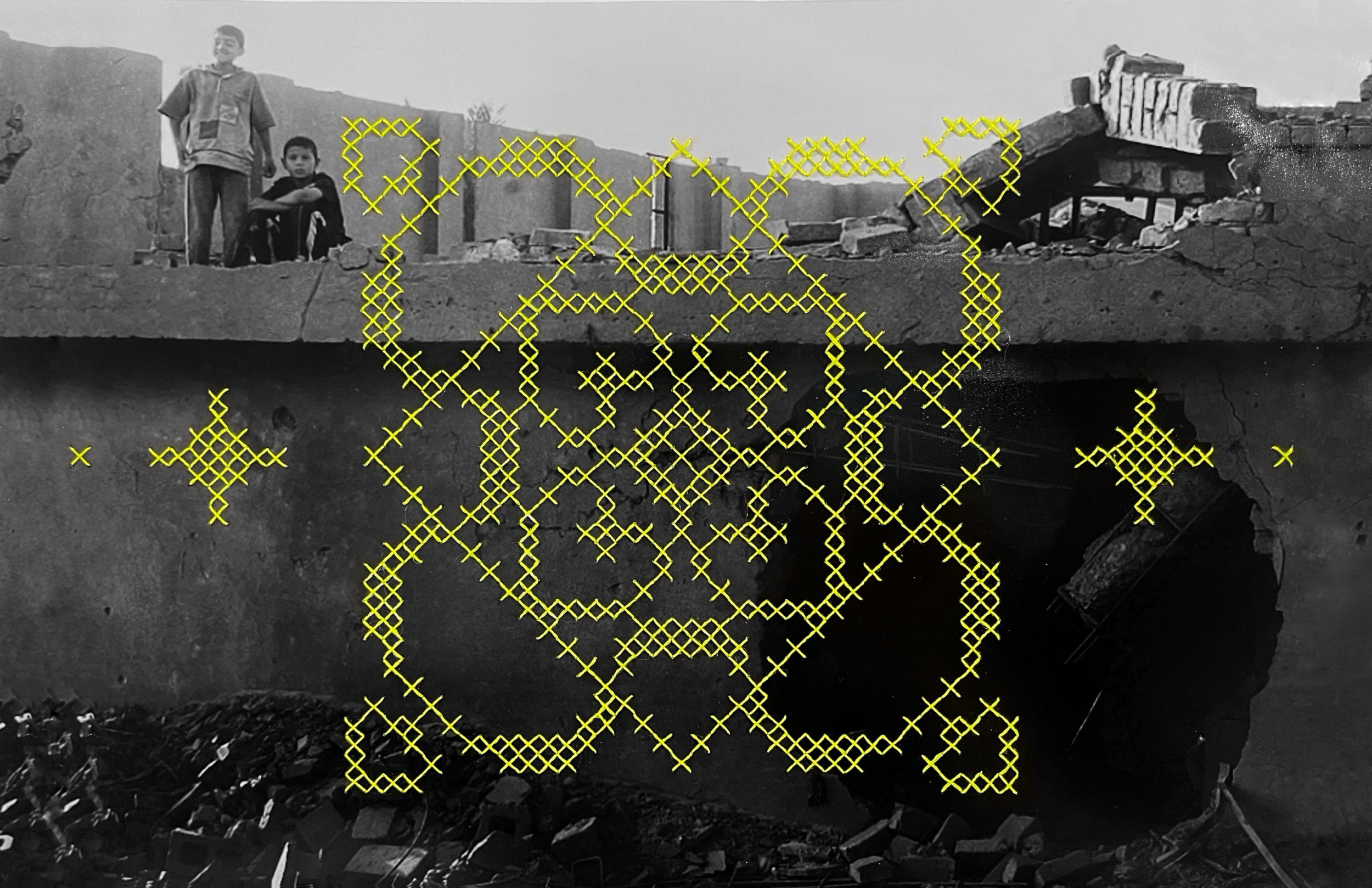
The Long Aftermath brings together three embroidered photographic works that examine how Iraq has been represented and remembered through images of war. The works follow a loose chronology, beginning with the U.S.-led invasion and airstrikes of 2003 in Baghdad and moving through subsequent violence in Fallujah and the destruction of Mosul. Together, the photographs trace a prolonged history whose effects extend beyond individual moments of violence, continuing through landscapes, communities, cultural memory, and the ways these places are represented.
Each work begins with a published photograph documenting a location in Iraq affected by conflict. The first draws from photographs of Baghdad during the opening airstrikes of the 2003 invasion. The second turns to Fallujah in 2004, during the military operations and insurgent violence that severely affected the city. The third depicts the Old City of Mosul in 2017, after years of instability, including ISIL's occupation of the city and the destruction that followed. Seen together, these photographs consider the accumulation of events that continued to shape Iraq in the years following the invasion.
The photographs are transformed through hand embroidery using motifs informed by Iraqi rug-making and wood-carving traditions. Rather than reproducing a specific pattern or presenting one tradition as representative of Iraq as a whole, the designs draw from a range of Iraqi decorative forms and are developed through the artist’s own process of drawing, combining, and stitching. The resulting motifs are not intended as exact reproductions of any particular traditional design, but as an interpretation of the forms and patterns that informed the work. Bringing together references from different sources reflects the diversity of Iraq’s regional and cultural traditions, without reducing them to a single visual identity.
The act of embroidery is central to the way the photographs are transformed. Each image is pierced and stitched by hand, requiring repeated handling throughout the making process. The photograph becomes more than a record of a particular moment; its surface is physically altered through hours of slow, repetitive work. The thread draws attention to the image while also obscuring parts of it, creating a shifting relationship between what is immediately visible and what lies underneath. The photographs retain their original evidence of destruction, but are interrupted by a process of making associated with care, craft, and touch.
The contrast between the photographs and the embroidered motifs brings together two histories that might otherwise be encountered separately. The photographs depict places through moments of violence and destruction, while the embroidery introduces forms connected to Iraqi craft and cultural traditions. Iraq’s recent history has been marked by repeated periods of war, occupation, displacement, and political instability. The effects of these events extend beyond physical destruction, affecting communities, homes, cultural heritage, and the transmission of knowledge and traditions across generations. By bringing these elements together on the same surfaces, the works place images of destruction alongside the cultural histories of the places they depict.
The Long Aftermath is ultimately concerned with the relationship between what is documented and what is remembered. The photographs preserve particular moments within Iraq’s history of conflict, while the embroidered surfaces introduce cultural forms connected to craft, memory, and inheritance. Together, the works consider how prolonged conflict can affect not only places and communities, but also the ways cultural knowledge and traditions are passed between generations. The embroidery does not replace or conceal the destruction in the photographs; instead, both remain visible alongside one another, allowing the work to consider what can be lost, what can be remembered, and what can continue to be carried forward through making.
Artist Statement
As an Iraqi Turkmen and first-generation Canadian, Noor K’s practice explores the relationship between Middle Eastern and Western visual culture through sculpture, installation, textile, and image-based work. Drawing from her cultural background and Middle Eastern visual traditions, she combines traditional patterns and materials with contemporary aesthetics. Her work reflects on identity, memory, displacement, and the experience of growing up between cultures.
Instagram: @4vrgrl
Exhibition Archive


Other Horizons: AUArts x SMFA Exchange Exhibition / 1.17-2.3.2025
It all begins with an idea.


